
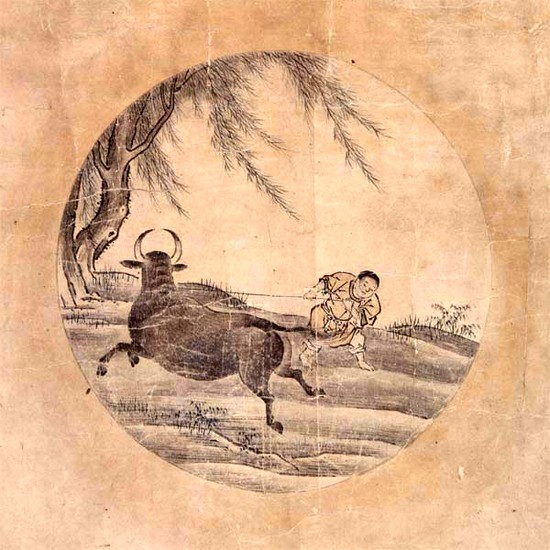
Dizang asked Fayan, “Where are you going?”
Fayan said, “On pilgrimage.”
Dizang said, “What is the purpose of pilgrimage?”
Fayan said, “I don’t know.”
Dizang said, “Not knowing is most intimate.”
– From the Book of Serenity, a 13th century collection of Zen Koans
There’s a feeling that I sometimes get in conversation, when I feel as though I’m at a slightly awkward dead end.
The conversation topic could be a new job, an emotional experience, a relationship, whatever, but this feeling arises when my brain goes cool, I now understand or have expressed everything that’s important about this, and there is nothing else to say or ask about it. We’re done.
Yes, you’ve told me that you’re angry with your ex, and why, and I understand, and it makes sense, and I’ve sympathised, and you know that I totally get it and that I care about you. So why is there still some pregnant charge in the air around this topic?
I recognise this in doing IFS-style parts work too. It happens when I’m hearing from a part (my own or somebody else’s), which has a particular view or a particular purpose in mind.
I understand exactly where this feeling came from – and what the implicit belief behind it is, and why it’s wrong, and how I picked that up from childhood. But it’s still not going away.
What’s common to these kinds of ‘dead end’ experiences is a grasping after knowing.
When you understand, you’re relating to a concept – a model – that’s useful (or at least you hope that it will be useful) for a particular purpose, like making sure that your friend feels adequately understood or undermining a painful belief. Surely you can get there if you just know enough, in the right way, with the right tools?
It’s reassuring to have a handle on reality, and sometimes understanding is – of course – very helpful. But understanding something will cut you off from presence with the real thing if you hold it too tightly. We can only understand things in relation to an agenda. That becomes the reference point around which things can be categorised as helpful or hindering, good or bad, a problem or a relief, clear or murky, not enough or too much.
When we have an agenda, then we try to know.
But true intimacy – with others, and with your own experience – can only arise from not knowing.
There is a space that opens when we set aside our knowings and our doings, our hopes and fears, in which we can simply be present with, and be in the presence of, the messy vitality of our humanness, and not have a handle on it – and for that to be totally okay.
If you’re trying to tame a bull, the idea of letting go of the handles feels terrifying and dangerous, just the absolute worst idea. You could get hurt. The bull, wild and intractable, in its refusal to present you with effective handles, has become a problem, an enemy.

But if you’re the wide open field, then you don’t need the bull to be a particular way, and the bull can start to be itself. Rather than experiencing it as your enemy, you can start to experience it as it actually is.
And the surprising thing is that there is no particular, final, ultimate, definable, static way that the bull is. It’s alive. It’s unpredictable. It’s inseparable from its environment. It may be friendly or belligerent, quiet or adventurous. You can never pin it down, you never fully control it, never get the same bull as the day before. And that can also become not a problem. More than just not a problem – a wonder. Something sacred. Even when it’s taking a big fat smelly dump.
Awakening as Intimacy
Intimacy isn’t a “thing” that you arrive at; not something you can write down clearly in a notebook to remind yourself about.
If you cling to something that feels like that, you’ll lose contact with the living reality of experience – your own, or somebody else’s, or both. You’ve got it, bottled it, that’s the end of the conversation.
You’ll be continually frustrated at reality when it doesn’t fit your model, or frustrated at your own stupidity and inability to get it right and finally take hold of the perfect handle. That’s what it feels like from the inside when you’re holding your understanding project too tightly; taking it too seriously.
Of course, psychological insights can be immensely useful, and it’s very useful to remind yourself about them. But insights aren’t some new extra thing that you add in to your experience. They’re better understood as a kind of dropping of a habitual way of looking. When you remove the lens from your eyes, then you can actually see the lens, rather than seeing through it.
The lens is probably some attempt to make sense of, control, or monitor, perhaps in service of avoiding some experience, or preserving your worth as a person, or your worthiness of belonging.
The insight that comes from dropping those lenses isn’t about better understanding – it’s that the lenses were optional. Intimacy is to receive somebody – or yourself – without lenses.
Or instead of “without lenses” it may be more accurate to say that you know which lenses are present, and you’re holding them lightly, with a flexible facility with some other lenses that might be helpful, but without taking any of them all that seriously – knowing that none of them can ever reveal the final truth.
Awakening is intimacy with your own nature. Which is why it’s not a “thing” that you can get, because it has no content, in the same way that intimacy isn’t about what kind of content is present. Only that the connection is open and alive and loving.
When we’re trying to know something, remaining in non-doing seems like… well, doing nothing. We expect that nothing will happen – the problem will keep being a problem.
But when your experience is held within that open space without agenda, and allowed to be itself, the question of whether it is a problem or not simply no longer applies. It just is.
Have you ever felt somebody convey, through their presence, in a way that you could really trust it: “You’re ok, just as you are. I’m with you, and there’s nowhere else I want to be. I know you as you are, I see you without any comparisons or judgements or ‘shoulds’, and I love you, just for being you.” Awakening isn’t about content – but it just so happens that holding yourself and your experience in this way is also deeply healing.
Compare that to being regarded as a problem and an enemy, and report back about which one makes you feel more capable of transformation.
With repeated experiences of loosening and letting go of handles, you begin to trust more and more that the bull can’t hurt the field – and you are the field. And so you’re able to hold more and more of yourself, more and more of the time, with that kind of warmth and presence.
There will still be problems to solve on the relative level of content – the bins need changing, attachment issues needs healing, democracy needs protecting, illnesses need curing – but the sense of problemness is replaced more and more by an open, loving intimacy with reality.
